

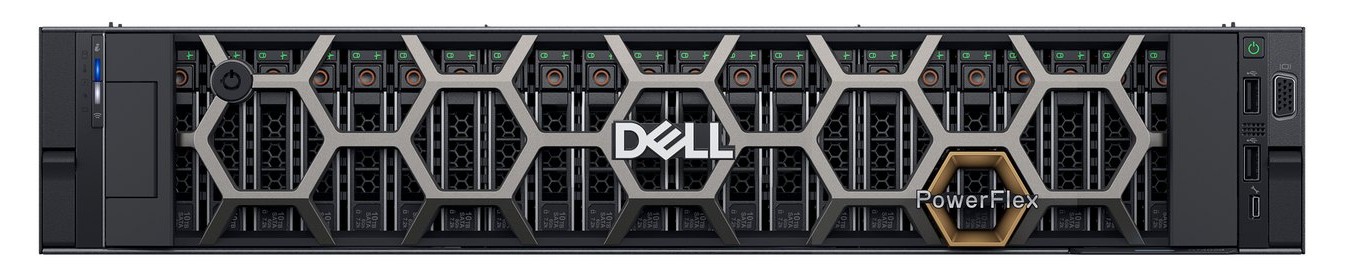
PowerFlex — software-defined infrastructure
Software-defined infrastructure (SDS) that binds x86 server nodes over TCP/IP, scaling compute and storage independently or together — built for mission-critical environments where performance and capacity demands are hard to predict.
WHY DELL
- Scale compute and storage independently — unlike conventional HCI that only grows in whole nodes, you add just the resource you need and cut cost
- Choose your hypervisor freely across VMware, Nutanix AHV and KVM — staying flexible as vendor licensing policies change
| Item | Specification |
|---|---|
| Minimum configuration | Starts at 4 nodes |
| Maximum scale | Non-disruptive expansion beyond 1,000 nodes |
| Max SDC / max SDS | 2,048 / 512 |
| Max raw capacity per node | 160TB (medium granularity) / 128TB (fine granularity) |
| Supported platforms | Bare metal · ESXi · KVM · Hyper-V · mixed Linux/Windows |
| Resilience | Six nines (99.9999%) Tier 1, fault isolation across multiple protection domains |
Dell Automation Platform
An upper-layer automation platform that orchestrates multiple private cloud deployment models — VMware Cloud Foundation, Azure Local, Nutanix AHV and DDPC — from a single control layer, with validated blueprint-based deployment and AIOps-driven operational optimisation.
WHY DELL
- Orchestrates VMware, Azure Local, Nutanix AHV and Red Hat from one control layer — a hybrid strategy free of vendor lock-in
- Dell AIOps converts telemetry into executable actions, enabling proactive operations rather than post-incident response
| Item | Detail |
|---|---|
| Positioning | A common control layer for private cloud deployment and AI operations automation |
| Supported cloud stacks | VMware Cloud Foundation 9.1 · Microsoft Azure Local · Nutanix AHV (PowerStore integration) · Red Hat · DDPC |
| Supported infrastructure | PowerEdge (including GPU acceleration) · PowerStore and Dell compute/storage/networking broadly |
| Relationship to DDPC | DAP is the common upper control layer; DDPC is one of the deployment models it manages, specialised for edge and distributed sites |
| Licensing | Portal and Orchestrator included at no cost; premium components such as Automation Studio are licensed separately |
Sources: Dell Automation Platform product page, Dell press release 19 May 2026, StorageReview
Dell Distributed Private Cloud
One of the deployment models orchestrated by DAP — edge and distributed infrastructure on its own hypervisor (DDPC OS), operated centrally with two-node HA clusters, automatic failover and zero-touch onboarding.
WHY DELL
- A purpose-built immutable OS (DDPC OS) provides HCI shared storage without separate licensing — lowering operating cost
- Two-node HA plus zero-touch onboarding brings unstaffed edge and distributed sites under central management
- Per-device flat licensing rather than core or capacity-based charging — expanding infrastructure does not scale licence cost proportionally, giving predictable TCO
| Category | Supported models |
|---|---|
| Intel rack servers | R670 · R770 · R660 · R760 · R570 · R470 · R360 · R260 |
| AMD rack servers | R6715 · R6725 · R7715 · R7725 |
| Tower / Rugged servers | T560 · T360 · T260 / XR4510C · XR4520C · XR8610t · XR8620t · XR5610 · XR7620 |
| Workstations / PCs | Precision 7960XL · 5860XL / Dell Pro Micro QBM1250 · Slim QBS1250 |
| GPU | NVIDIA L4 · A16 · L40S · H100 NVL · H200 NVL · RTX Pro 6000 SE |
| License type | Target devices | Use |
|---|---|---|
| Standard | Category 1–3 (Dell Pro / workstations through R660/R760/R770) | Single-server virtualization |
| Advanced | Category 1–3 (same device range) | HCI |
Licence tiers — per-device subscription, expandable with no limit on core count or storage capacity
Considering Dell private cloud?
Tell us what you need — configuration, pricing, or a technical review. The relevant division will respond directly.